Wednesday, June 15, 2011

Everybody believes in retail

Note: Blogger is not letting me move pictures how I want. This would have been out sooner but I messed with the look for an inordinate amount of time
In what I described as the working class neighbourhoods there are lots of little shops. I don't think they have zoning. Shops seem to spring up more as a result of natural flow of people. The buildings get built at times with no seeming relationship to each other. Where there is a street or passageway there may be shops, or not. It would be easy to assume that the streets were planed but sometimes it's hard to tell. 

Dan does not cook and has nothing to cook with so we eat out at small restaurants. Even quite late all manner of shops are open. Most of them are just small rooms with a window as part of the door opening. They fall into a few main categories:
they are about 10'x12'
  • vegetable stands
  • butcheries 
  • hair places
  • internet cafes
  • dry goods retail stores
  • restaurants and bars
  • furniture
  • clothing and shoes(much of it used from the US and Europe)
  • schools...there are tons of small private schools
We even came across one book store that also did dry cleaning.(caveat emptor) Most of his books were school text books and about 1/4 of the others were books I knew the author or had heard of the movie.

2 charcoal stoves
While there are lots of small shops they have very shallow inventory. When you go into a restaurant you have to ask what food they have. They may have a menu but that means nothing. Eat what they have, it will probably be good.  I have not eaten anything bad yet, although the beef is gristly. The restaurant will almost apologetically tell you that all they have is African food but it is good anyway. My diet has gotten a bit heavier in the beans department-with predictable results. We also always have a soda with our meal since we don't trust the water. Any benefit I might have from lower calorie food is lost right there. Most of the small shops still cook on a charcoal stove although there is a mix of gas and electric too.

there's a road in there somewhere
Along the major roads there are stalls in the area between where the side walk would be and the buildings. The stall roofs are made of whatever is cheap and unlikely to be stolen. Even with this density of retail selling there are still vendors hawking their wares by walking about. A favourite seems to be selling pantihose. I have no idea why, my guess is that they are soft and light.

Many of the shops don't have running water and buy water from guys with push carts for 25 cents for 5 gallons. These guys also sell to people who have not paid their water bill or have a broken pipe the city has not fixed.

Tuesday, June 14, 2011

Matatus

The cheapest transportation in Kenya are called matatus.  Tatu is Swahili for 3. A long time ago there was a 3 partner car company that gave rides. Today a small bus is know as a matatu. When I was in high school they were pick up trucks with campers on the back. They had a bench down each side and wire mesh over the windows. The wire mesh on the windows was, I presume, to keep passer bys from reaching in and stealing things. It also made it much harder to get out in the event of a crash. We were strictly forbidden from ever riding in them.

Today the government regulates them a little better. They come in a variety of sizes. I'm not totally sure where a matatu ends and a bus begins. For the sake of this blog, any cheap local transportation in Kenya is a matatu. The smallest ones are cab-over flat nosed Toyota mini vans. They are generally white and have a  yellow dotted line down the side. The line is required by law.  Painted on the side it says 14 passengers (well, it actually says 14 pass). One of those 14 is the conductor. The conductor will get out at each bus stop and yell out the destination as well as the price. There are sort of customary prices but ultimately the price is whatever the conductor thinks people will pay. When someone is getting on the conductor will bang on the side of the bus so the driver doesn't pull out. The drivers often like to hurry people along by creeping forward to make it look like they are leaving so they run to get on. The conductor will bang to let the driver know someone wants off. Each guy has his own style as far as banging goes with some mixing in whistles or banging a coin on the window.


Matatus are privately owned and have no set schedule.  They generally leave certain pick up areas only if they are full but may leave the end of the line mostly empty and stop in more populated areas until full. They compete against each other and will skip stops if another company is there on the basis that they got all the passengers (unless you want off).  There have been times when a bus was too full for me and the next one just blew by as the first was leaving. During the day the wait is usually less than 5 minutes.
Notewiki says Dallas' population density is 634/sq mi vs 11,678.3/sq mi in Nairobi

At busy times or when the conductor feels safe from cops, like late at night there will be 16 people in the back and the conductor will stand in the door and lean out of the van...usually yelling out to various passer bys.

The roads are 2 lanes each way with no markings whatsoever. They are hugely overcrowded and there is a constant jostling for position. At least a third of the traffic are buses, many of which are dropping people or pulling out into traffic. The drivers actually have quiet a high level of professional consideration. They weave and bob and often drive 3 across. On roads with no medium they drive down the wrong side and make on-coming traffic scoot over. They push into lanes where there are no gaps and suck up the gaps so tight that when traffic stops, pedestrians have to turn sidewise to fit between buses. The good thing is that they do this at relatively low speeds. When an American free would have all but 2 lanes shut down for an accident they would find 4 or 5. 

From where we live it takes 2 buses to get into down town, a distance of about 9 miles. The ride costs about half a buck. After the matatu is under way the conductor collects the fair. He folds the bills length wise and wraps them between his fingers like a paper brass knuckle. The coins he keeps in his right hand and shakes them at you as if to say 'pay up sucker'.

Saturday, June 11, 2011

The neighbourhood

Like any city, Nairobi has different neighbourhoods with differing income levels in each. The area where Jason stayed when he was with Samaritan's Purse is very upper class. Each house has a wall with a security guard at the gate and a large yard. The houses are very nice.


View from Dan's window
Where Dan is staying is what I would consider middle class condos. The complex is divided into several neighbourhoods with a guarded main gate. There are also guarded gates at the entrance to  each neighbourhood.  Most of this area has paved main roads and dirt, I hesitate to call them roads...places a car can pass provided it does so slowly and with a maximum of bumping about. Dan's condo has paved roads and a few people even have cars.

Surrounding neighbourhoods have a mix of security levels. Some are 5-8 story buildings which have a secured main entrance. Others are 2 story duplexes with a small gated yard that have just enough room for 2 cars to park.  Poorer areas have a door leading to a side walk with rooms on each side. I suspect each room is just big enough for a bedroom but I have just caught glimpses of these down open outside doors. The poorest of the poor live in what we would think of as sheet metal slums type houses. It is easy to pull the sheet metal back and steal from them. They may rent for as little as $20 a month. Where the upper class area is in a different part of town these differences in housing are next to each other and are often just separated by a fence. In places you can see where sheet metal walls are being replaced by stone as people have money.

Dan is new to this area, so over the last few days we have gone out exploring and searching for local places to eat. This whole area is very densely populated and most people take buses (more on those later).  When they are not riding about, people walk. There are no side walks for the most part so the sides of the road not covered by stalls (again more on that later too) are bare dirt. Beside the road are almost always ditches. Often any trash gets thrown either into the ditch or next to the road. There are a surprising number of chickens scratching in this trash. The surprise being that they are not stolen outright. Every so often someone sets the more combustible of this trash on fire. While this is a convenient way to deal with the problem it has the result that lots of soot gets into the water supply and the streams run black. In fairness there are probably also other things in the water contributing to it's constitution.


This area of Kenya has a volcanic rock that is fairly easy to quarry. Most things are built with it. Most of the buildings in this area are either 2 story town homes or 5-8 story apartments and condos.

note rebar left for future building on chemist
The basic way to build is have 4 pieces of re-bar in columns and a slab floor. Rock fills in the area between columns. All of the interior walls are also rock. Two story houses use just rock since it is strong enough to be a structural building material. This construction style has the benefit of giving termites a headache. It does make for echoie houses if you have no furnishings like Dan.

The concrete generally gets covered with painted plaster, sometimes the rock does too. The inside walls also get plaster and paint. Be sure you have the picture where you want it because hanging it will require a drill and anchor.  Most of the roofs have tile although this development has green metal tiles.

most look better
There is another harder rock that fractures like flint and doesn't have smooth sides. It comes in shades of green, yellow and pink and most of the time gets put up looking pretty rough although when they take their time it can be cut smooth and looks better than the volcanic rock which is grey like concrete.

All of the scrap rock gets put out into the dirt road or just left laying about. It makes for some gritty sand that tracks everywhere and wears through the surface of ceramic tile in the entrance of stores.

Thursday, June 9, 2011

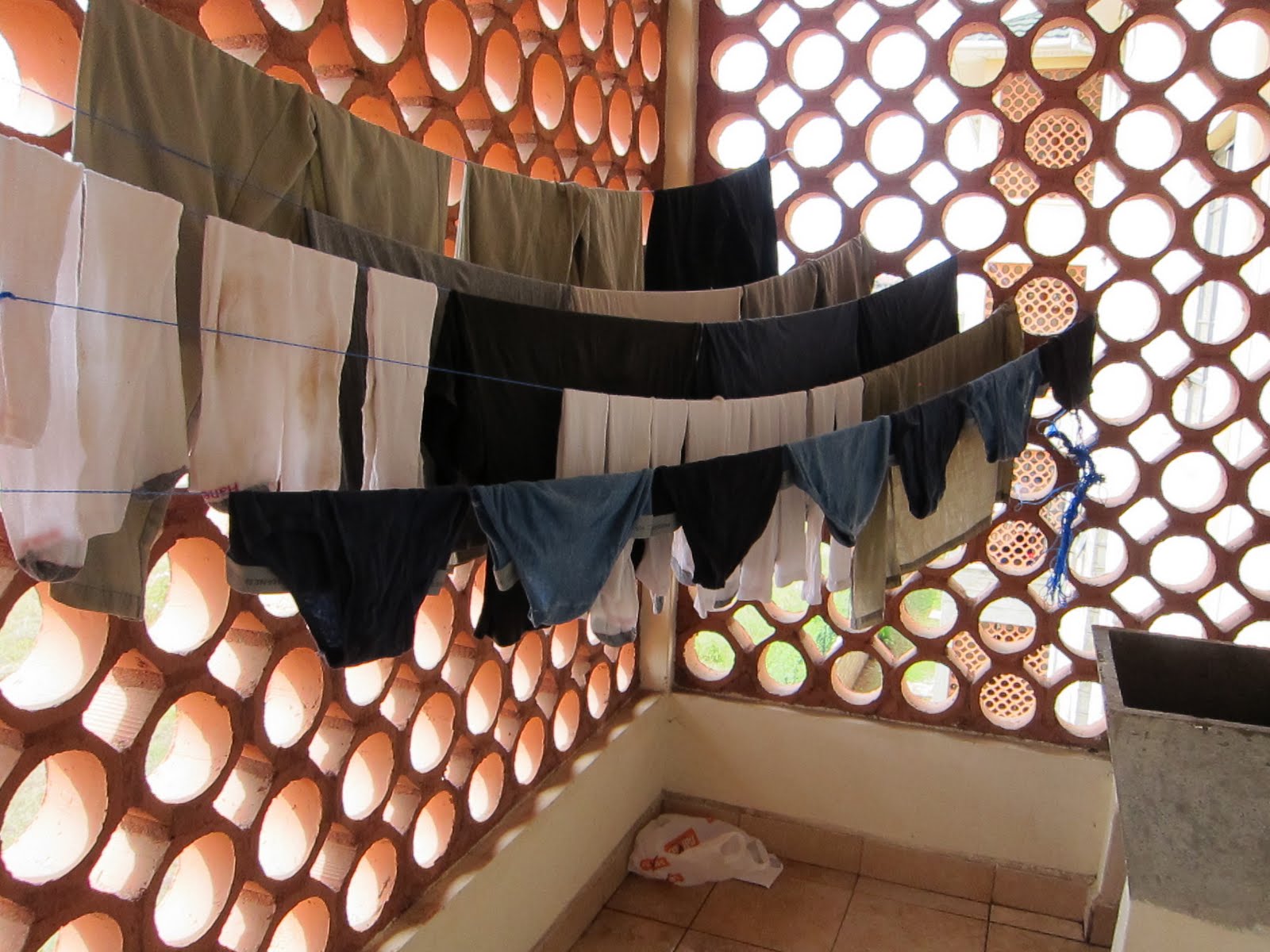
Laundry

The premise of travelling light is that eventually I will need to do laundry. If I take fewer clothes I will have to wash them more often but they will be vastly easier to carry. Yesterday was the first time I did laundry. Ever, as it turned out. Up till now I would have said I had done laundry hundreds of times. In reality I loaded a machine and let it do the work.


Every thing I know about washing clothes I learned from a machine. I'm not sure this is a good idea. What if the machine is just a poor copy of a much better human process? I don't think the process I used really makes for that good of reading. In the end my inner militant feminist was quiet angry with the man, and it was a man who designed the utility sink to have it's bottom at knee level. In reality most Kenyans wash their clothes this way and often actually from tubs sitting on the ground.

Once I was done that Kris Kristofferson song lyric
Then I fumbled through my closet for my clothes,
And found my cleanest dirty shirt
was starting to have a certain kind of appeal.

Update They came out and hooked up the high speed internet yesterday afternoon so no more waiting around the house.

Wednesday, June 8, 2011

Mercers

Friends, greetings

I am currently working on what will probably end up being 4 blog entries but they keep changing as I learn more about this area. Till then let me tell you about the Mercer family.


The Mercers are missionaries with World Venture who are from Irving and are friends of the Valerius, Imler and Arnold families. The missions committee met with them last fall before they returned to Kenya, which is where I met them. At the time, I said I was returning to Africa and was invited to visit them, which I did Yesterday.

Until now I have always travelled with Dan. Currently Dan is trying to get high speed internet installed and is being told that someone will arrive "tomorrow before 11, 2, by the end of the day". Such is the nature of the optimistic mind that this has been going on for 2 weeks now and each day begins with that wonderful glimmer of hope. Yesterday Dan went down to the corporate offices and gave them a piece of his mind. We still don't have high speed internet but this morning we have regained hope.

So I travelled alone. The trip was basically across town, a distance Google maps says is 27 miles. I allowed myself about 70 minutes. By the time I was on the third bus nearly an hour had passed. For the last 5+ years arriving on time has been of utmost importance so I gave Mark a call. As I sat fretting about waiting on a bus it came over me that I am now on AFRICA TIME. The Mercers have been in Africa going on 20 years and know all about Africa time. So yea, I'm now recalibrated. The trip took another hour.

Mark teaches at Nairobi Evangelical Graduate School of Theology which is part of Africa International University. He teaches Hebrew in the Biblical Studies Department. I wrote all that down and if it's not right it's my fault...sorry Mark.


The campus is as you would expect. A beautiful campus with buildings and housing and somewhere for the students to grab a Coke. During our conversation I asked how much research they had done about Kenya before they came. As it turns out, about as much as my parents-not much. What they said is no one prepares you for how beautiful Kenya is or how modern.

It was encouraging to hear that, like many other places I had seen in '05, the Africans are taking over leadership here at AIU. The university was the vision of a DTS grad from Nigeria who saw that many of Africa's brightest minds left the continent, never to return, when they went to university in the States or Britain. Naturally, being in Africa it has many students that would never have been able to go overseas for schooling. Students do come here from the surrounding countries too.

I asked how Mark and Susie came to be in Kenya. Mark had been teaching at a Bible school part time and working a second job to make ends meet. They heard of the need here and decided to give it a year to see how it worked out. Mark described himself as 'not a salesman and not someone who would be good at raising support.' The one year has turned into now 20 with God being faithful to put it into the hearts of people to support them. As I type this the passage in 2 chronicles 16:9 comes to mind that says "For the eyes of the LORD run to and fro throughout the whole earth, to show Himself strong on behalf of those whose heart is loyal to Him". That passage was written as a warning to someone who was not faithful to God, but it is encouraging to spend time with a person with a lifetime of faithfulness.

In an earlier post I mentioned how my being debt free is what has allowed me to come to Africa as I have. It should be noted that when the Mercers decided to come here they were also debt free....I made it a point to ask. Selah.

On the return trip I was able to gain 20 cents worth of experience in not taking the right bus. It all ended well.

Saturday, June 4, 2011

Sahara

This is a post mostly to mess with putting maps into a blog, truth be told.


Usually I have a hard time sleeping on planes. On this trip for some reason I was able to get in a few small naps. I had just awoken from one when I happened to look out the window. What appeared at first to be clouds turned out to be the Sahara desert. I commented on it, then the people in the next row were also suddenly interested and taking pictures. Before you know it, there was a small group of us at the back of the plane taking pictures out the back door window where the view was better. We flew over landscape that looked like this for an alarmingly long time when you consider we were moving at 520 miles an hour.

Nile above Aswan dam

View sahara in a larger map


You get what you get with my blog. I was interested in this so this is what you get.

Thursday, June 2, 2011

Initial impressions


Friends
Some of you asked how long this trip would take so here is a brief breakdown of each leg of the trip. I was up by 6am and to the airport by 10. There was a 2-3/4 hour wait then a 2 hour flight. A 3 hour layover and a 7-1/4 hour flight. Another 2 hour lay over and finally an 8 hour flight. Kenyan customs and immigration were simple, straightforward and fast.

Dan was front and center to meet me and I am at his place now. He has just moved into this apartment and has almost no furnishings. His boss in the US was concerned that he would be able to get paid, so he worked on smoothing out payroll before the immigration paperwork. I had reported to some of you that a work permit was $10,000, that is not quiet the case. That is what it costs when you get a lawyer involved to expedite the paperwork. The result is that Dan is getting paid but the company is adamant that he not work till his work permit is sorted.

The apartment is in a new complex with security on the front gate and on the building gate. He lives on the 4th floor which at this elevation I sort of felt in my chest whilst carrying my case up last night. It is a 3 bedroom 2 bath with nice tiles on the floor. The kitchen still needs a stove and fridge. I'm giving the bathrooms a 9. The master is all in the same room but the other has a sink and then a separate room for the shower and commode.

Which brings us to the shower. The water heater is built right into the shower head and has 3 settings. hot, warm and cold. The temperature can be further moderated by how much water flows since the heater can't keep up with the flow at high volume. Quiet frankly I am concerned by the type of thinking that thinks wiring 220 volts directly into the shower head is a good idea. Also the drain is in the corner of the room which is not the low spot. I'm suggesting a squeegee.